K.J. Holdom
Simon & Schuster
Otago Daily Times, May 23rd 2026
The seeds of K.J Holdom’s debut novel were planted during a visit to the German Military Cemetery in Normandy, when she came across the records of Edmund Baton, a young man whose remains were interred there. According to the German War Graves Commission, Edmund was born in Saarland, a province on the Franco-German border in 1931. In 1945 he, like many boys his age, was evacuated to a Children’s Camp in Bavaria from where “Due to his homesickness, [he] made his way home … together with a schoolmate and without the knowledge of his parents.” How he managed this, and what took place during the journey are not recounted.
Unable to imagine her own sons in Edmund’s shoes, Holdom wanted to expand his story beyond the confines of this brief synopsis. But the work, developed from her prize-winning Masters of Creative Writing project, is more than just the story of an individual. Saarsland was returned to Germany in 1935 after 15 years under French administration and the novel explores the war’s impact on those who found themselves on opposite sides of borders that “cut a line through a region that had shared a thousand-year history, culture, church, language and blood…a line through a family and an entire community.”
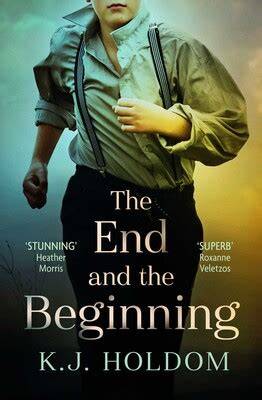
As the son of mixed French/German parentage, Max Bernot is determined to prove himself a brave and strong son of the Germany and the Fürer. But his loyalty wanes as the war progresses and he sees the impact of Nazi violence on his own family: His father arrested for currency crimes, his Uncle Joseph sent to Burchenwald; and his beloved Godfather Charles, newly escaped from a labour camp, shot and killed in front of his eyes. So when, in March 1945, he and his fellow Hitler Youth are sent into combat from their training camp in Bavaria, Max has no desire to defend a fatherland he no longer believes in, he and his best friend, Hans, instead set off for home. It is a long and dangerous journey that takes them directly past the advancing Allied forces. But far from finding safety in newly-liberated France, the boys are dispatched to a civilian interment little different from the Nazi concentration camps that have so shocked the world.
Meanwhile his mother Marguerite and sister Anna are also far from home, pressed into the service of a Nazi officer in the German interior. It is a situation with dangers of its own, particularly for a young woman like Anna, and their story interweaves that of Max and Hans. Both narratives are also intercut with scenes from the past, at the heart of which is Charles’ murder and the unresolved question of who informed on him to the Feldgendarmerie.
Although fictional, the people and events in The End and the Beginning are based on Edmund’s own letters and first-hand accounts by his surviving family members, whom Holdom was able to locate and interview. The delicacy, diligence, and fidelity with which she has recreated his story are testament to her skills as both journalist and author.