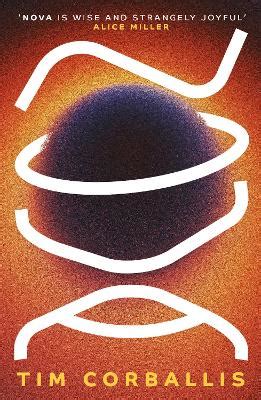
Tim Corballis
Te Herenga Waka University Press
Otago Daily Times, July 18th 2026
Wellington writer Tim Corballis’s latest novel, a work of speculative fiction set in on the deep-space generation ship NOVA, synthesises his various interests in power, philosophy, politics, and possible futures, into a rich and thought provoking tale that defies easy
NOVA’s human inhabitants live in a series of self-contained communities, moieties, each with its their own, specialised role in maintaining the ecosystem for a purpose that “transcended its individual people…[something] human and not human, larger than human.” But a mere 300 years into a 60,000 year voyage, there are already signs that the centre cannot hold. The physical and ecological environment is deteriorating. Inter-moiety meetings have ceased as people increasingly defer to the ship’s AI, System, as arbiter on matters of shared concern. And there are others living beyond the confines of the moieties whose presence and activities are neither acknowledged nor accounted for.
Kalla, a former moiety leader, is becoming increasingly frustrated by people’s refusal of recognise the evidence of entropic forces on the social and ecological system. Such complacency and unwillingness to change, she believes, risks losing something ineffably human: “Life can’t go on”, she rages “just with making and using eating and fucking”.
System shares Kalla’s unease. Not only are there are parts of themself they cannot access, something is draining unsustainable amounts of energy. And when a near-fatal accident fractures the barrier between the moieties and outside, Kalla and an isolated strand of System’s awareness venture beyond the breach in search of answers. What they find is anathema both, but the differences between those on either side of the boundary must be reconciled if NOVA is to arrive at its destination with a living cargo.
The challenges facing NOVA and its inhabitants may be tropes of the genre but remain highly relevant to the present day: What sacrifices are required to maintain a functioning and stable systems in a closed and resource-limited environment? How might individuals collaborate in the interests of goal that will only be realised many generations in the future? Can this be achieved without fundamental changes to our sociopolitical systems of law and governance, or should it be left to an algorithm to uphold laws and determine which ‘non-necessary’ pursuits can be dispensed with in the name of efficiency?
Corbalis’s solution, which combines the meaning- making but transitory aspects of embodied life with AI’s capacity to anticipate every eventuality on a journey so long it defies human comprehension, is surprisingly optimistic. But it is his exploration of the role and nature of artificial intelligence that is the most memorable aspect of the novel, not least his decision to give the narrative to System rather than one of the human protagonists. It plays with language and form in a way that both suggests and disavows Systems’ self-awareness, bifurcates as they carry out simultaneous conversations with different characters, and is interrupted by discursions into everything from systems theory to state-legitimised violence. It is a novel that requires a level of concentration that some may find challenging, but its rewards are more than worth the effort.