Vincent O’Malley
Bridget Williams Books
Otago Daily Times, February 14th 2026
Culture, Vincent O’Malley writes in the introduction to the updated edition of his account of pre-Treaty relationships between Māori and Pākehā “[Is] something that can be created, defined and ‘articulated’ in the encounter situation.” What emerges from such encounters depends on context, particularly the balance of power between groups, as many Indigenous populations can testify. But O’Malley’s interest lies in the earlier phase of the process, the ‘middle ground’ in which both parties have a mutual need of the other. Here groups can consciously evaluate and assert their unique cultural priorities and identities; adapt new ideas and technologies to their own purposes; and develop shared meanings and practices to mediate their interactions.
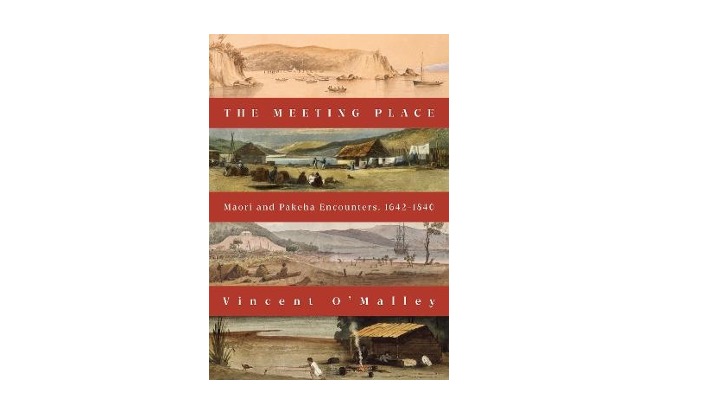
Covering everything from trading relationships to sex on the frontier, religious encounters to politics, The Meeting Place details the ways in which Māori and Pākehā adapted in response to one another, defining themselves and one another in the process, and traces the impact of these encounters on cultural identity and practice across a broad range of transactions.
O’Malley identifies the period from the establishment of the Church Missionary Society station in Rangihoua in 1814 through to 1840, when the influx of settlers in the wake of Te Tiriti tipped the balance of power in favour of Pākehā, as one such ‘middle ground.’ Drawing on a broad range of scholarship, and written and oral histories, he traces the history of interactions between Māori and Pākehā from the first encounters between European explorers and individual hapū and iwi in the 17th and 18th century (when mutual incomprehension frequently had tragic outcomes) to the organised European settlement in the first half of the 1800s.
Although not glossing over the negative impacts of this early phase of colonisation on Māori, O’Malley argues persuasively that this was characterised by adaption and accommodation rather than acculturation: “[Not a] pre-existing culture collapsing when confronted with a supposedly stronger and superior one….but rather of a conscious process of reflection and re-evaluation.” Māori were resilient and adaptable, quick to adopt new technologies and practices to their own ends, but many of the apparent cultural changes were superficial, or only applied in areas where they interacted with Pākehā. Similarly, missionaries and early settlers reliant on local Iwi for support and protection married into local communities, learned Māori, and (reluctantly) observed tikanga, but worried about the impact of Māori culture on their children. (As it transpires such concerns were unwarranted; many missionary children became the most visible agents of colonisation). Superficial or not, such accommodations worked for both parties, at least until the balance was overturned.
Originally published in 2012, this updated edition of The Meeting Place contains new material on early interactions in Te Wai Pounamu, illustrations that provide additional contextual detail, and an updated bibliography. But its re-release is perhaps most important as a reminder that it is possible for Māori and Pākehā to maintain their unique cultural identities while co-existing in a state of mutual tolerance and co-operation Bolstered this time around, one hopes, with a deeper understanding and respect.