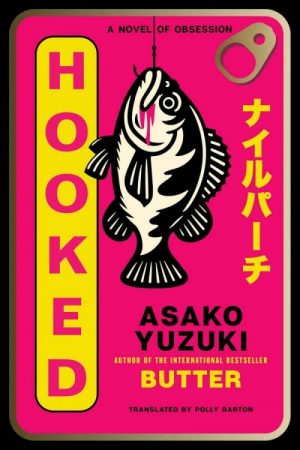
Azako Yuzuki, translated by Polly Barton
HarperCollins
Otago Daily Times, July 25th 2026
Predating Butter (the only other of Asako Yuzuki’s novels to be translated into English to date), Hooked won the Yamamoto Shūgorō Prize in 2015 and deals with similar themes, including misogyny, family dysfunction, the superficial, performative and obsessive nature of many social (and parasocial) relationships.
At first glance it seems odd that The Diary of Hallie B, The World’s Worst Wife, in which a woman with neither job nor children recounts her time spent ignoring housework and eating out at conveyer sushi joints, should be one of Japan’s top Homemaker blogs. Perhaps it reassures other stifled housewives, whose lives are not reflected elsewhere on social media, that they are OK. But for Eriko Shimura, a consumately professional career woman, it is the fact that neither of them has a social life that gives her hope. Indeed, she comes to regard their mutual friendlessness as a point of connnection and, when a forensic examination of the comments and images in the blog reveal that ‘Hallie’ (whose real name is Shōko) lives not far from her own home, Eriko arranges an ‘accidental’ meeting in the hopes of translating this imaginary relationship in real life.
Initially flattered by the approach, Shōko becomes alarmed by the subsequent texts and calls with which Eriko bombards her and blocks her new acquantance, prompting Eriko to everything in her power, up to and including blackmail, to re-establish contact, with catastrophic results.
Her actions may be appalling, but Eriko, who appears to be somewhereon the autistic spectrum, remains a surprisingly a sympathetic and vulnerable character. She finds the rules governing social interactions mind-boggling and, heroic attempts at self-justification notwithstanding, recognises her approach to relationships is deeply dysfunctional. Her needs and obsessions are as distructive to herself as to her victims, and some of the most painful moments in the novel involve her personal and professional humiliation by a co-worker, whom she neither likes nor respects, in the hopes of learning the secret of female friendship .
Despite the bleakness of this synposis, Hooked is far from depressing, however. As is fitting for a satire about the constraints on women’s lives, themes of appetite and consumption abound, including sensual descriptions of food (another of Eriko’s obsessions) which dissipate tensions that might otherwise become overwhelming. And by the novel’s end both women have not only recognised the ways in which their own behavious and expectations reflect the relationships modeled those of their parents, they have taken the first steps towards independence.
My one quibble is that the development of character and theme is often more explicit than implied, which at times feels heavy-handed: Eriko “[craves] to be part of an intense connection, to ascertain her own contours through another”; Shōko recognises that “the thing that sets women against one another …is not only society and other big structures. Maybe it all started with the individuals closest to you.” But this is a minor flaw in an otherwise thoroughly enjoyable novel, and I look forward to English publications of Yuzuki’s other work.