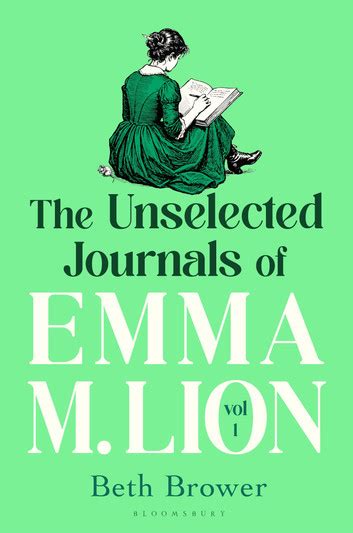
Beth Brower
Bloomsbury
Otago Daily Times, August 8th 2026
Today’s authors must not produce something both familiar enough to be commercially attractive and original enough to stand out from the thousands of others, both human and AI, attempting to do the same, they must also be accessible and responsive to their target audience in a way that would have once been impossible. In The Unselected Journals of Emma M. Lion, Beth Brower has approached these challenges through a combination of well-established and new (dare I say novel?) approaches.
The journals, which are set in London during the late 19th Century, detail the trials and tribulations of their titular diarist’s daily life in the quirky neighbourhood of St Crispins. They open with 20-year-old Emma’s return to the colourfully monikered Lapis Lazuli House after three years in the of service a disagreeable relative. Orphaned at 13, this should by rights mark a turn for the better, since a combination of her wages, the house, and its associated living (which she will inherit on her upcoming birthday) should allow her to live an independent, if modest life. So it is a bitter surprise to discover ‘Cousin’ Archibald, who has been overseeing her assets in her absence, has spitefully squandered them, and she is in very real danger of losing her home. The only solution is to let out Lapis Lazuli Manor, a 10m sliver of the house that Archibald has walled off in the previously-unfulfilled hopes of luring a wealthy tenant. However, despite finding herself landlady to a Byronesque war photographer, and the subject of several young men’s attention, her future remains far from secure.
Although the use of diaries as a way of engaging readers in an on-going story is not new, Brower has attempted to give the format a fresh twist by approaching it as if it were a television series. Thus, each journal (two of which are collected here) covers 2 months of Emma’s life and constitutes an episode in a year-long ‘season’, with the show’s entire run to extend over 4 seasons. There is also tie-in subscriber-only substack featuring Brower’s own journal along with episodes of the St Crispian’s Gazette, that includes scenes, letters and other stories about the peculiar neighbourhood and its assorted inhabitants.
It is a clever idea, and there is much to like about the writing, which has a decidedly Wes Anderson sensibility to both plot and imagery. But at 100-150 pages each, the journals’ brevity and unhurried pace are not enough to constitute a satisfying novel without further investment. Whether it is worth it is a moot point. Despite Emma’s apparently desperate plight, she spends her days doing very little, her main occupations being daily walks around St Crispen and, under the direction of her Lady Bracknell-like Aunt Eugene’s directing the attention of marriageable young men towards her cousin Arabella. Despite hints at a darker past, the first two volume of Emma M. Lion’s unselected diaries resemble blancmange: light and inoffensive, and too insubstantial to make a satisfying meal.